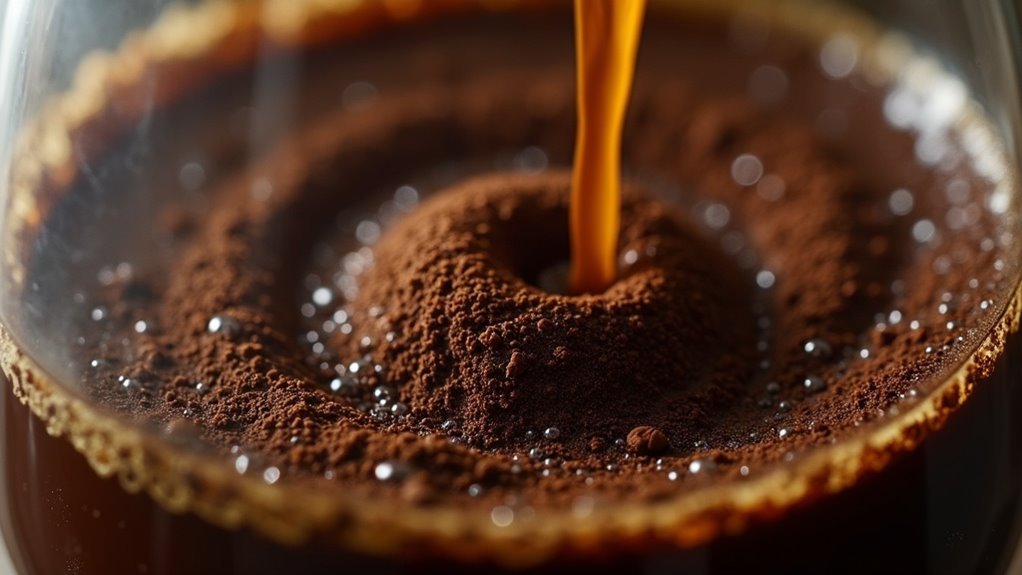
Agitation changes extraction because it enhances the interaction between water and coffee grounds, improving the release of flavor and aroma. By increasing contact between water and coffee particles, it ensures even saturation, preventing under-extraction. Different levels of agitation can affect solubility, influencing the overall taste profile—gentle stirring may bring out sweetness, while excessive movement can lead to bitterness. Timing also plays a crucial role in achieving the ideal flavor. This balance is essential for a rich coffee experience, which you will learn more about below.
Key Takeaways
- Agitation enhances the interaction of water with coffee grounds, leading to improved extraction of flavor compounds and a higher overall yield.
- It ensures that coffee particles are uniformly saturated, which helps prevent under-extraction and promotes a balanced flavor profile.
- Varying levels of agitation can change the solubility rates of flavor compounds, ultimately impacting the taste of the brew.
- Controlled agitation can significantly boost extraction yields, with increases observed between 5.4% and 8.6%.
- The timing and intensity of agitation play a crucial role; too much movement can result in bitterness, while gentle stirring encourages sweetness in the final cup.
Understanding Agitation in Coffee Brewing
Agitation plays a vital role in coffee brewing, influencing the extraction of flavors and aromas. When you incorporate agitation, you enhance the interaction between water and coffee, ultimately improving extraction yield.
This process helps guarantee uniform saturation of coffee grounds, preventing under-extraction and promoting a balanced brew. Different agitation levels can considerably alter taste; gentle stirring may enhance sweetness, while excessive movement risks bitterness.
Timing and duration are essential—initial gentle agitation helps distribute water evenly, but prolonged agitation must be managed to avoid over-extraction.
The Chemistry of Agitation
When you consider the chemistry behind agitation in coffee brewing, you’re examining how it influences the solubility of flavor compounds.
This movement not only enhances the interaction of these compounds with water but also accelerates the extraction rate, leading to a more flavorful cup of coffee.
How do different levels of agitation affect these processes, and what balance do you need to strike for the ideal brew?
Solubility of Flavor Compounds
Understanding how flavor compounds dissolve in water is fundamental for brewing the perfect cup of coffee, as the solubility of these compounds directly affects the extraction process.
Agitation enhances solubility by increasing the contact surface area between water and coffee particles, promoting efficient extraction. It breaks up clumps of coffee grounds, ensuring even water distribution and preventing uneven extraction.
Ideal agitation levels can greatly increase extraction yields, boosting solubility from 5.4% to 8.6%.
Different brewing techniques influence dissolution rates, leading to variations in flavor profiles.
Grasping the relationship between agitation and solubility is vital for achieving balanced extractions and delightful brews, making it essential knowledge for any coffee enthusiast.
Impact on Extraction Rate
The impact of agitation on extraction rate is profound, as even subtle changes can greatly alter the flavor profile of your coffee brew.
By enhancing contact between water and coffee particles, agitation markedly increases the extraction rate, raising yields from 5.4% to over 8.6%.
Different brewing methods require specific agitation levels; for example, immersion techniques thrive on consistent stirring to guarantee uniform extraction and balanced flavors.
However, over-agitation can extract unwanted bitterness, emphasizing the need for precision.
Understanding the chemistry behind agitation helps you fine-tune your coffee-making approach, ultimately serving others a more refined and enjoyable coffee experience.
How Agitation Influences Extraction Rates
While many factors influence extraction rates in coffee brewing, agitation stands out as a crucial element that can significantly impact flavor.
Agitation markedly enhances contact between water and coffee particles, promoting an even distribution of soluble compounds. Research indicates that controlled agitation can improve extraction yields by 5.4% to 8.6%, depending on the brewing method used.
Agitation improves water-coffee contact, enhancing flavor extraction by 5.4% to 8.6%, depending on the brewing method.
For immersion techniques, stirring is vital, while pour-over methods benefit from periodic agitation to achieve a balanced flavor profile.
However, excessive agitation can lead to over-extraction and bitterness, so it’s essential to fine-tune your approach, taking into account timing and brew duration for optimal results.
Timing and Agitation: The Perfect Balance
When you consider the timing of your coffee agitation, you’re directly influencing the flavor and aroma extraction of your brew.
Finding that sweet spot between initial gentle agitation and longer durations is key; too much agitation can lead to over-extraction and undesirable flavors.
How can you master the timing to achieve a balanced profile that enhances your coffee experience?
Agitation Duration Impact
Understanding how agitation duration impacts flavor extraction is fundamental for any coffee enthusiast aiming to perfect their brew. The duration of agitation directly influences extraction rates, with initial gentle stirring essential for breaking clumps and ensuring even water distribution.
While longer agitation can intensify flavor complexity, it risks over-extraction, introducing unwanted bitterness. Consequently, balancing the timing of agitation is critical; early gentle movements enhance saturation, while extended agitation should be approached cautiously.
Optimal Agitation Timing
Achieving the perfect balance in coffee brewing hinges on ideal agitation timing, as this critical factor significantly influences the extraction process.
Gentle initial agitation breaks up clumps, ensuring even saturation and balanced extraction. However, be cautious—prolonged agitation risks over-extraction, leading to bitterness, while insufficient agitation results in under-extraction and a weak flavor profile.
Mastering the timing-agitation relationship allows you to enhance specific brewing methods; for instance, a quick swirl post-bloom can elevate flavor clarity without bitterness.
Agitation Across Different Brewing Methods
Agitation plays an essential role in the extraction process across various brewing methods, influencing the flavor profile of your coffee.
Agitation is crucial in coffee brewing, significantly impacting the extraction and flavor profile of your cup.
To effectively agitate the coffee, consider these techniques:
- French Press: Consistent stirring breaks up clumps, ensuring even water distribution for rich flavors.
- V60 Pour-Over: Controlled water flow and periodic stirring promote uniform saturation of coffee grounds, enhancing balance.
- Cold Brew: Minimal agitation prevents over-extraction, maintaining smoothness while slowly coaxing out flavors.
Understanding how to brew coffee with tailored agitation strategies is vital for delivering an exceptional cup that delights your guests’ palates.
Optimizing Cold Brew With Controlled Agitation
When brewing cold brew coffee, optimizing extraction through controlled agitation can significantly enhance your beverage’s flavor profile.
By incorporating regular agitation, you improve extraction yield, potentially increasing it from 5.4% to 8.6%. This process helps break up coffee grounds, ensuring even water distribution, which is crucial for extracting soluble compounds.
With a typical coffee-to-water ratio of 1:4 to 1:8, adjusting agitation levels allows you to fine-tune flavors to your liking.
Additionally, utilizing automated machinery like the Hardtank minimizes the risk of over-extraction while ensuring consistent quality across batches.
Ultimately, understanding and applying controlled agitation can elevate your cold brew into a more balanced and flavorful experience for coffee enthusiasts.
The Role of Equipment in Agitation
Precision in brewing equipment plays a pivotal role in enhancing the agitation process during coffee extraction. The right tools can considerably affect the uniformity of water interaction with coffee grounds, ultimately improving flavors.
Precision in brewing equipment is essential for optimal agitation, ensuring uniform water interaction with coffee grounds and enhancing flavor.
Consider:
- Automated machines that guarantee consistent agitation and reduce human error, ensuring a perfect brew every time.
- Immersion devices that promote even extraction by maximizing water contact, leading to a richer flavor experience.
- Dispersion screens that regulate flow, preventing clogging while optimizing agitation, thus maintaining the integrity of your brew.
Each piece of equipment influences the extraction rate, affecting the final cup’s flavor profile.
Expert Insights on Agitation and Extraction
Understanding the dynamics of agitation in the brewing process can greatly enhance your coffee experience. Agitation promotes uniform exposure of coffee grounds to water, notably improving extraction.
Research shows that controlled agitation can raise extraction yields from 5.4% to 8.6%, underscoring its significance in crafting the perfect cup. Different brewing methods demand varying levels of agitation; for instance, a French press benefits from thorough stirring, while pour-over techniques require gentler movements.
Timing is also crucial; initial gentle agitation ensures even saturation, while prolonged stirring may lead to undesirable bitterness. It’s essential to balance grind size and agitation, especially in high-extraction brews, to avoid unpleasant astringency.
Serve your coffee with intention and savor the nuances!