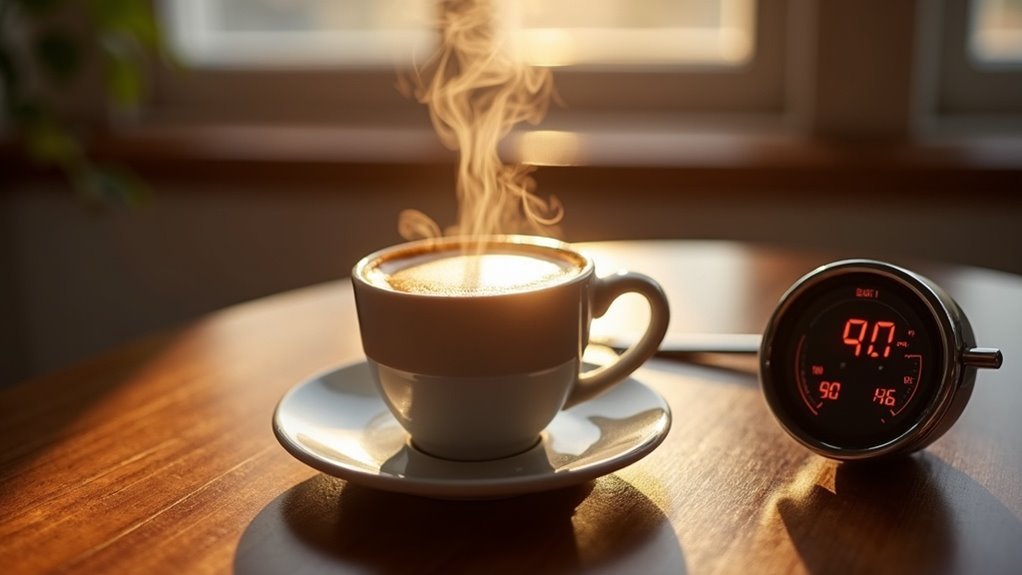
For brewing espresso, you should aim for a water temperature between 195°F and 205°F. Dark roasts thrive at 195°F to 198°F, while light roasts are best extracted at 202°F to 205°F. Traditional blends sit comfortably at 199°F to 201°F. Accurate temperature control across your espresso machine’s components guarantees ideal flavor extraction and consistency. Understanding these nuances can enhance your coffee experience considerably. Discovering how each factor contributes to your brew can elevate your espresso crafting even further.
Key Takeaways
- The ideal water temperature range for brewing espresso is between 195°F and 205°F.
- Dark roasts should be brewed at 195°F to 198°F for optimal flavor extraction.
- Traditional blends perform best at 199°F to 201°F, balancing taste characteristics effectively.
- Light roasts require a higher temperature of 202°F to 205°F to enhance complexity.
- Consistent temperature control across the espresso machine components is crucial for quality results.
The Importance of Water Temperature in Espresso Brewing
Water temperature plays a crucial role in brewing the perfect cup of coffee, especially espresso, as it directly affects the extraction of flavors. Consistency in temperature is vital for achieving a reliable quality in every brew.
Brewing at higher temperatures can enhance extraction yields, but it may also overpower the flavor profile, particularly with darker roasts, which are best brewed between 195°F and 198°F. Conversely, lighter roasts thrive at higher temperatures, around 202°F to 205°F, for optimal extraction.
Utilizing PID controllers for precise temperature management can help maintain these ideal ranges, ensuring that every cup you serve highlights the best flavors and complexities of your coffee.
Ideal Extraction Temperatures
When brewing espresso, hitting the ideal extraction temperature is essential for revealing the full spectrum of flavors in coffee.
Generally, you’ll want to target a range of 195°F to 205°F, but adjusting for roast type can make a significant difference.
Dark roasts thrive at lower temps, while light roasts require higher settings to showcase their complexity, so keep these nuances in mind as you brew your coffee.
Optimal Temperature Range
Achieving the perfect espresso requires precision, and the ideal extraction temperature plays a crucial role in this process.
The best temperature range for espresso brewing lies between 195°F and 205°F (90°C to 96°C). Here’s a quick guide to help you:
- Dark Roasts: Brew at 195°F to 198°F (90°C to 92°C) for deep, rich flavors without bitterness.
- Light Roasts: Use higher temperatures, around 202°F to 205°F (94°C to 96°C), for complex flavor profiles.
- Traditional Blends: Aim for 199°F to 201°F (93°C to 94°C) to properly extract balanced characteristics.
Temperature control is key for optimal flavor extraction in your coffee brewing!
Roast Specific Adjustments
To brew the perfect espresso, you need to adjust extraction temperatures based on the roast profile of your coffee beans. Darker roasts thrive at lower water temperatures, around 195-198°F (90-92°C), enhancing rich flavors without bitterness. In contrast, lighter roasts benefit from higher brewing temperatures, typically 202-205°F (94-96°C), to reveal their complex sweetness.
| Roast Level | Ideal Temperature (°F) | Notes |
|---|---|---|
| Dark Roasts | 195-198 | Enhances deep flavors |
| Traditional Blends | 199-201 | Balances bitterness and sweetness |
| Light Roasts | 202-205 | Achieves complexity and sweetness |
Adjusting your brewing temperature according to the roast can significantly elevate your coffee experience.
Temperature Control Across Espresso Machine Parts
Understanding temperature control across the various components of an espresso machine is vital for brewing the perfect cup of coffee.
Each part plays an important role in maintaining the right temperature for espresso, which affects brew time and overall flavor.
Here are three key components:
- Boiler: Keeps water at 204-205°F (95-96°C) for ideal brewing conditions.
- Group Heads: Operate 3-4°F lower than the boiler, around 200-202°F (93-94°C), which is essential for minimizing heat loss during extraction.
- Portafilter: Should be heated to 160-170°F (71-77°C) to enhance extraction and positively impact espresso quality.
Mastering these temperatures ensures that you achieve consistent, delicious results with every brew.
How Different Coffee Types Need Different Temperatures
When brewing coffee, the temperature you choose can greatly influence the flavor profile of different bean types.
Dark roasts thrive at lower temperatures, around 195-198°F (90-92°C), preserving their rich flavors without bitterness.
In contrast, light roasts need a higher temperature of 202-205°F (94-96°C) for ideal extraction of their complex notes.
Ethiopian coffee beans excel at 202-203°F (94-95°C), highlighting their floral characteristics, while Colombian beans prefer around 200-201°F (93-94°C) for balance.
Traditional espresso blends reach their perfect temperature at 199-201°F (93-94°C), ensuring a harmonious extraction from your freshly roasted ground coffee.
Adjust your brew time accordingly to enhance the unique attributes of each coffee type!
Common Temperature Problems in Espresso Extraction
While brewing coffee can be an art, common temperature problems often undermine the quality of your cup.
To guarantee you serve good coffee, first understand how temperature affects extraction:
- High Temperatures: Above 205°F can yield bitterness with shorter brew times of 15-18 seconds.
- Low Temperatures: Below 190°F causes sour flavors, often with extended brew times exceeding 35 seconds.
- Heat Loss: Cold portafilters and cups lead to flavor compromise and inconsistent quality.
Master Your Espresso Machine Temperature!
To master your espresso machine temperature for making the best coffee, it’s essential to understand the ideal brewing range of 90°C to 96°C (195°F to 205°F).
Utilizing temperature control techniques, such as PID controllers, will help you maintain consistency and achieve the perfect extraction for your coffee.
Optimal Temperature Range
Mastering the ideal temperature range for brewing espresso is essential for unlocking its full flavor potential. Aim for a suitable water temperature between 90°C to 96°C (195°F to 205°F) to achieve balanced extraction and rich flavor profiles.
Here are some key points to consider:
- Dark roasts thrive at lower temperatures (90°C to 92°C).
- Light roasts require higher temperatures (202°F to 205°F) for optimal complexity in flavors.
- Maintain a consistent brewing temperature, as fluctuations over 3°F can negatively impact your espresso.
Temperature Control Techniques
Achieving consistent brewing temperatures is essential for extracting the best flavors from your espresso. Invest in a PID controller to manage water temperature accurately, adjusting the heating element based on real-time readings.
Always check your machine’s boiler temperature, aiming for 204-205°F (95-96°C) for peak extraction. Allow a 30-minute warm-up period to stabilize components like the group head and portafilter.
Use a coffee thermometer to ensure your water stays within the ideal range of 195-205°F (90-96°C). Preheating your portafilter and cups can help prevent heat loss during brew time, enhancing the taste and richness of your final espresso.