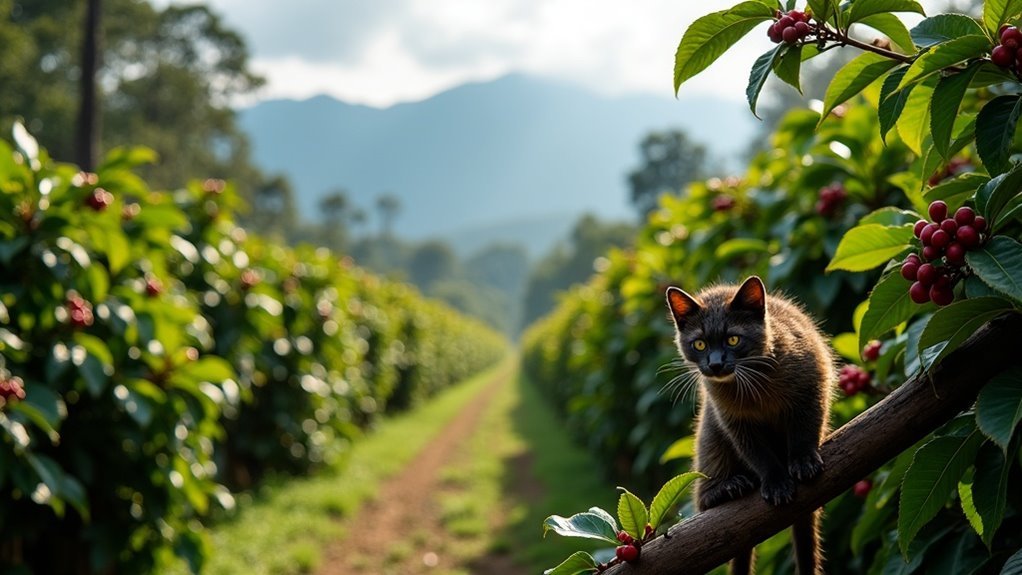
Kopi Luwak is primarily produced in Indonesia, particularly in regions such as Sumatra, Java, Bali, and Sulawesi. The fertile volcanic soil found in Sumatra’s Gayo Highlands and Java’s Pangalengan Highlands plays a significant role in enhancing its flavor profile. While other Southeast Asian countries, including the Philippines, Thailand, and Vietnam, also contribute to the production of this unique coffee, Indonesia is widely regarded as the gold standard. A deeper understanding of how local conditions and the diets of civets impact the quality of Kopi Luwak can provide valuable insights into this fascinating coffee’s production process.
Key Takeaways
- Kopi Luwak is primarily produced in Indonesia, with notable regions including Sumatra and Java.
- The Gayo Highlands in Sumatra is renowned for its rich volcanic soil, which enhances the flavors of the coffee.
- Java’s Pangalengan Highlands is also a significant source of high-quality Kopi Luwak beans.
- Additionally, other Southeast Asian countries such as the Philippines, Thailand, and Vietnam contribute to the production of Kopi Luwak.
- Indonesia sets the standard for Kopi Luwak, playing a crucial role in shaping global demand and production practices for this unique coffee.
The Origins of Kopi Luwak
Kopi Luwak, celebrated for its distinctive production process and exceptional flavor, has its roots in Indonesia dating back to the Dutch colonial era in the early 1700s.
Local farmers observed that civets, which roamed coffee plantations, would consume ripe coffee cherries and subsequently excrete the beans. This unintentional discovery led to the creation of Kopi Luwak, primarily harvested from regions like Sumatra and Java.
As global interest in this unique coffee has surged, both wild-sourced and farmed production methods have emerged. While Indonesia continues to be the primary source, the intriguing history of Kopi Luwak showcases a rich tapestry of cultural practices and economic influences, highlighting its esteemed position in the world of coffee.
Key Producing Regions in Indonesia
While Indonesia remains the epicenter of Kopi Luwak production, specific regions stand out for their exceptional quality and unique growing conditions.
Sumatra, particularly the Gayo Highlands, offers rich volcanic soil and a climate that enhances the flavor profiles of coffee cherries consumed by civets.
Sumatra’s Gayo Highlands, with its rich volcanic soil, elevates the flavor profiles of civet-consumed coffee cherries.
Java’s Pangalengan Highlands also excels in producing high-quality beans.
Bali and Sulawesi contribute notably as well, each showcasing distinct characteristics in their Kopi Luwak.
Although other Southeast Asian countries produce Kopi Luwak, Indonesia’s primary regions—Sumatra, Java, Bali, and Sulawesi—set the standard for excellence in this unique coffee experience.
Other Southeast Asian Countries
Although Indonesia is the most renowned producer of Kopi Luwak, several other Southeast Asian countries have also carved out their niche in this unique coffee market.
In the Philippines, farmers in Batangas and Cavite harvest beans from wild civets, contributing to the local coffee production.
Thailand’s Chiang Mai region showcases civets foraging for coffee cherries amidst lush agricultural landscapes, creating a distinct flavor profile.
Vietnam’s Central Highlands supports both civet habitation and coffee cultivation, enhancing its output of this exotic brew.
Meanwhile, East Timor is beginning to explore Kopi Luwak production, leveraging its coffee-growing regions to meet the growing demand for this unique beverage.
Factors Influencing Quality and Flavor
The unique qualities of Kopi Luwak stem from several interrelated factors that profoundly shape its flavor and overall quality.
Kopi Luwak’s exceptional flavor arises from the intricate interplay of diet, fermentation, origin, and roasting techniques.
Consider these key elements:
- The civets’ diet enhances the flavor profile by selecting only the ripest cherries.
- The fermentation process occurring in the digestive system reduces acidity, resulting in a smoother taste.
- The origin of the beans, such as from the Gayo Highlands and Pangalengan Highlands, contributes distinct flavor characteristics.
- The health and stress levels of civets have a direct impact on the quality of the beans produced.
- The roasting process plays a crucial role in determining aroma complexity and reducing bitterness.
Each of these factors intertwines to ensure that the final cup of Kopi Luwak offers not just coffee, but a carefully nurtured experience.
The Impact of Global Demand on Production
As global demand for Kopi Luwak coffee escalates, its production landscape undergoes significant transformations.
Primarily sourced from Indonesia, production has surged, prompting the captivity of civets and raising ethical concerns over animal welfare.
Unfortunately, high prices—up to $500 for 250 grams—fuel fraud, with inferior products often misrepresented as authentic Kopi Luwak coffee.
This demand has also led to expansion beyond Indonesia, with other Southeast Asian countries participating in production.
However, a growing emphasis on ethical sourcing encourages some producers to revert to harvesting beans from wild civets, ensuring enhanced quality and integrity in the coffee market.