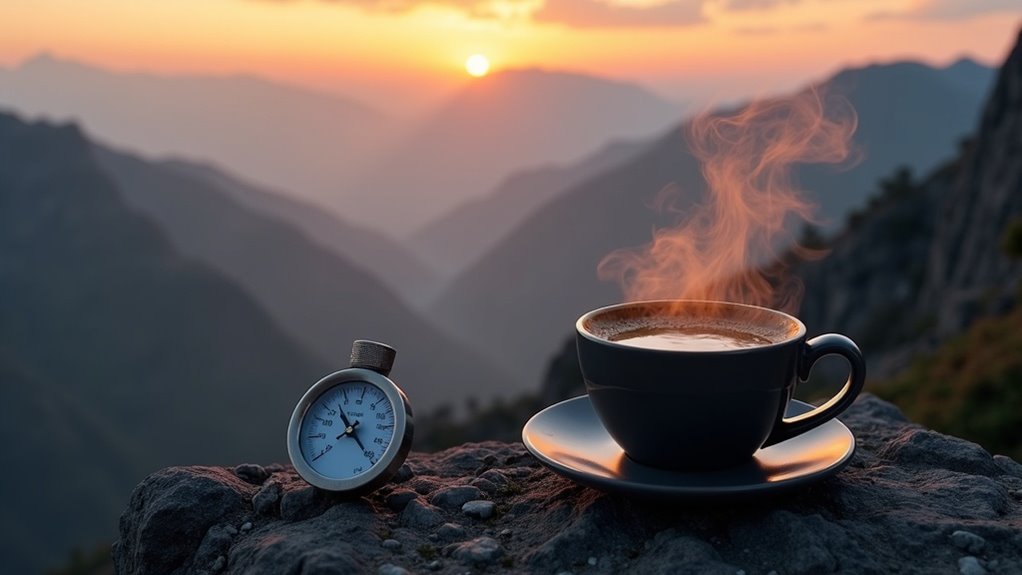
The boiling point of water decreases as you rise in elevation, which significantly impacts your coffee brewing process. At high altitudes, brewing temperatures typically hover around 192°F, which is below the ideal range of 195-205°F for optimal extraction. This lower temperature can lead to under-extraction, resulting in sharper acidity and a less complex flavor profile in your coffee. To counteract this issue, using finer grind sizes and employing specific brewing methods can help enhance extraction. By making careful adjustments and closely monitoring your brewing process, you can greatly elevate your coffee experience. There is much more to discover regarding techniques for optimizing extraction and improving your coffee enjoyment.
Key Takeaways
- The boiling point of water decreases with elevation, which impacts the brewing temperature for coffee lovers.
- At high altitudes, brewing temperatures typically range from 192-194°F, falling short of the ideal range of 195-205°F that many coffee enthusiasts strive for.
- Lower brewing temperatures can lead to under-extraction, resulting in sharper acidity and diminished flavor complexity in your cup of coffee.
- To counteract weak extraction at high elevations, consider using finer grind sizes and increasing the amount of coffee.
- Maintaining consistent temperature control and experimenting with different brewing methods are crucial for optimizing coffee flavor when brewing at altitude.
Understanding the Boiling Point of Water at Different Elevations
As you ascend in elevation, you’ll notice that the boiling point of water decreases, which significantly impacts various coffee brewing processes.
At sea level, the boiling point is 212°F, but at 5,000 feet, it drops to about 202°F. At even higher elevations, like 8,800 feet, it can plummet to 192°F.
This reduction in boiling point affects brewing temperature and can lead to under-extraction, resulting in weak flavors in your coffee.
To compensate, consider using finer grind sizes and increasing the amount of coffee, ensuring you achieve a robust brew even at high elevations.
The Relationship Between Altitude and Coffee Brewing Temperature
Understanding how altitude affects your coffee brewing temperature is essential for achieving ideal flavor extraction.
At high elevations, the boiling point of water decreases, typically hovering around 192-194°F (89-90°C). This lower boiling point means your brewing water may not reach the ideal brewing temperature of 195-205°F (90-96°C), resulting in under-extraction of coffee flavors.
To compensate, consider using finer grind sizes and increasing coffee amounts. Standard methods often yield weak coffee at these altitudes; consequently, manual brewing or calibrated brewers are more effective in optimizing extraction temperature, ensuring a richer, more flavorful cup that meets your coffee enjoyment standards.
Effects of Lower Boiling Point on Coffee Flavor and Aroma
When brewing coffee at high altitudes, the lower boiling point of water impacts the extraction temperature, resulting in under-extraction of essential flavors and aromas.
This can lead to a cup that has a sharper acidity and reduced complexity, as important solubles may not dissolve properly.
To enhance your coffee’s flavor profile, consider adjusting your brewing method. You might try using a finer grind or increasing the coffee-to-water ratio for a more balanced and enjoyable cup.
Extraction Temperature Variations
Although the boiling point of water decreases at higher altitudes, this shift greatly impacts the extraction temperature during coffee brewing.
At elevations above 8,800 feet, water may only reach 192-194°F (89-90°C), leading to under-extraction of essential flavors in your coffee. Consequently, your brew might taste weak and lack complexity, missing the sweetness that ideal extraction temperatures provide.
To counteract this, consider using finer grind sizes or increasing your coffee dosage.
Understanding how water temperature affects extraction at high altitudes is crucial for delivering quality coffee, ensuring you maintain a balanced and flavorful cup that delights those you serve.
Flavor Profile Adjustments
As you brew coffee at higher altitudes, the lower boiling point of water significantly affects the flavor profile and aroma of your cup.
Brewing temperatures may drop to 192-194°F, resulting in under-extraction of essential oils, acids, and sugars. This often leads to a bland, weak taste, with an emphasis on sourness and a lack of sweetness.
To achieve optimal extraction, it’s essential to adjust grind size and brewing methods, opting for finer grinds and cooler water to avoid over-extraction.
Understanding the impact of lower boiling points on flavor is crucial, as improper temperature control can obscure the complex flavors and aromas that contribute to a high-quality coffee experience.
Brew Method Recommendations
While brewing coffee at high altitudes, it’s crucial to choose methods that adapt to the lower boiling point of water, typically around 192-194°F.
Opt for pour-over or calibrated brewing methods to guarantee consistent brew temperatures and enhance flavor extraction. Adjust your grind size to be finer and consider increasing the coffee amount to counteract weaker extraction caused by the altitude.
For espresso, tweak your grind size and brewing techniques to maintain ideal flavor profiles, accounting for temperature drops during extraction.
Monitoring brew temperature and employing techniques like shorter water dances can greatly improve your coffee’s quality at elevated elevations.
Enjoy brewing your coffee at high altitudes!
Adjusting Brewing Techniques for High Altitude
When brewing coffee at high altitudes, understanding the impact of lower boiling temperatures is essential for achieving ideal flavor extraction. To optimize your brew, you’ll need to adjust your grind size and brewing methods. Experimenting with a finer grind and modifying brewing times can enhance extraction quality.
| Adjustment | Recommendation |
|---|---|
| Grind Size | Finer than usual |
| Brew Time | Slightly longer |
| Brewing Method | Prefer manual over automatic |
Local espresso bars can provide valuable guidance on specific blends and techniques tailored for high-altitude brewing, ensuring you maintain excellent flavor quality in your coffee.
The Importance of Consistent Temperature Control
Brewing coffee at high altitudes requires more than simply adjusting grind size and brew time; consistent temperature control is crucial for optimal extraction.
At elevated altitudes, the boiling point of water is lower, which can result in brewing temperatures that adversely affect flavor. It’s essential to maintain brewing temperatures between 92–96°C (198–205°F); failing to do so may lead to weak coffee.
Utilizing automatic coffee machines equipped with elevation calibration ensures consistent temperature control, while manual brewing methods offer flexibility.
Ultimately, mastering temperature management will significantly enhance the flavor and aroma of your coffee.
Recommended Brewing Methods for Elevated Locations
When brewing coffee at high altitudes, it’s essential to adjust your techniques to account for lower boiling points.
Opt for manual methods like pour-over or French press, which offer better temperature control than standard brewers.
Additionally, using a finer grind and increasing the coffee amount can significantly enhance extraction and flavor, resulting in a more satisfying cup of coffee.
Adjusting Brewing Techniques
As you refine your coffee brewing techniques for high-altitude locations, it’s crucial to recognize the effect of decreased boiling points on your brew.
Here are some targeted strategies to elevate your coffee experience:
- Choose pour-over or calibrated brewing methods for consistent extraction results.
- Utilize a finer grind size to enhance extraction at the lower temperatures typical of high altitudes.
- Increase the amount of coffee used to counterbalance the reduced brewing efficacy experienced at altitude.
- Experiment with different brew ratios to discover your perfect combination of temperature and flavor profile.
Optimal Equipment Choices
Choosing the right equipment is essential for achieving ideal coffee extraction at high altitudes, where boiling points drop considerably.
At higher elevations, opt for pour-over or manual brewing methods that allow for precise temperature control. Standard batch brewers often fail to reach the best extraction temperature, leading to weak coffee.
Instead, use calibrated brewers specifically designed for altitude conditions. For espresso, adjust grind size and employ a flush-n-go technique to maintain brew temperature.
Don’t hesitate to consult local coffee experts; their insights can guide you in selecting the best equipment and refining your brewing techniques for optimal flavor.
Experimentation and Adaptation for Optimal Coffee Extraction
Although brewing coffee at high elevations presents unique challenges due to the lower boiling point of water, experimentation with various methods can lead to ideal extraction.
To optimize your coffee brewing process, consider the following adjustments:
- Use finer grind sizes to enhance extraction efficiency.
- Increase coffee amounts to balance for reduced brewing temperatures.
- Experiment with different brew methods tailored for altitude.
- Monitor and adjust brewing times to align with local boiling points.
This website is dedicated to exploring and enhancing your coffee experience, providing insights into the art of brewing at different elevations.