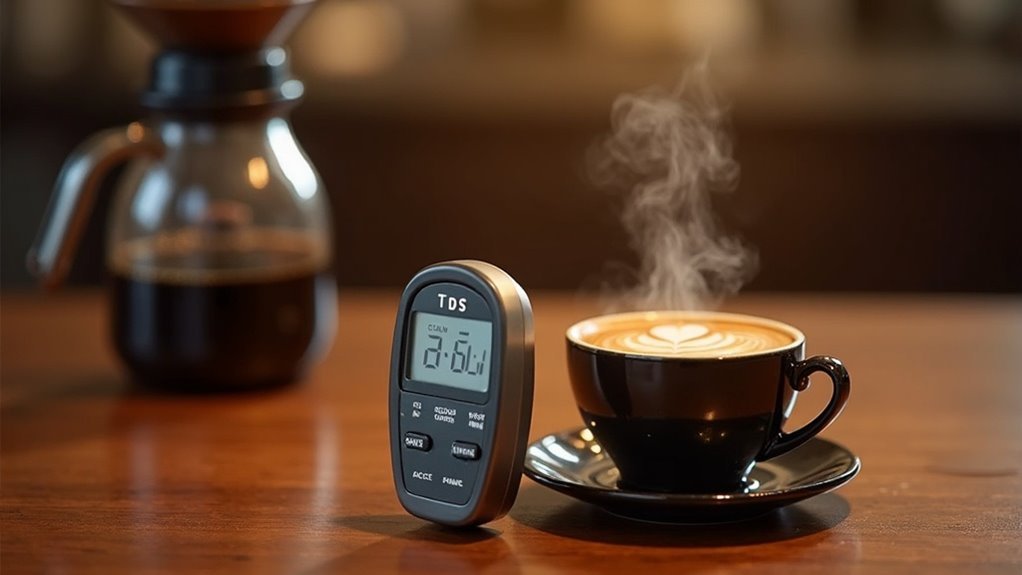
A TDS meter for coffee measures total dissolved solids, providing valuable insights into your brew’s extraction efficiency. By assessing the electrical conductivity of your coffee, it helps you determine if you’re within the ideal TDS levels—1.2-1.7% for brewed coffee and 8-12% for espresso. This measurement is crucial for fine-tuning your brewing technique to enhance flavor. However, it’s important to note that TDS doesn’t capture all the intricacies of brewing; understanding its limitations can significantly improve your coffee quality. Dive deeper to explore all aspects of TDS in coffee brewing and elevate your coffee experience.
Key Takeaways
- A TDS meter measures the total dissolved solids in coffee, providing insights into extraction efficiency during the brewing process.
- TDS is represented in parts per million (ppm) and indicates the strength of the coffee solution.
- For brewed coffee, ideal TDS levels range from 1.2% to 1.7%, while espresso typically has TDS levels between 8% and 12%.
- TDS meters gauge electrical conductivity using two electrodes but do not identify specific minerals that influence flavor.
- Monitoring TDS can enhance brewing techniques and help achieve the desired flavor profiles by adjusting extraction percentages.
Understanding TDS and Its Importance in Coffee
Understanding TDS (Total Dissolved Solids) is essential for anyone serious about crafting the perfect cup of coffee, as it directly reflects the extraction efficiency during brewing.
TDS measures the concentration of dissolved substances in brewed coffee, indicating how well your beans have released their flavors. Ideally, TDS levels for brewed coffee should range from 1.2-1.7%, with espresso reaching 8-12%.
TDS reveals the concentration of dissolved compounds in coffee, with optimal levels of 1.2-1.7% for brewed coffee and 8-12% for espresso.
By monitoring TDS, you can gauge extraction percentages, aiming for 18-22% to enhance flavor. A refractometer helps you measure these values, allowing for precise adjustments in grind size, coffee-to-water ratios, and water quality to elevate your coffee experience.
Understanding and manipulating TDS can significantly improve your brewing technique, ensuring that each cup is rich and flavorful.
How a TDS Meter Works
A TDS meter functions by measuring the electrical conductivity of your coffee solution, providing insight into the concentration of dissolved solids in your brew.
It uses two electrodes to assess conductivity, with pure water serving as a benchmark due to its low dissolved content. TDS measurement is expressed in parts per million (ppm), making it easy to understand the quality of your coffee.
For the best results, calibrate your TDS meter with a 442 Natural Water™ Standard Solution, applying a conversion factor of 0.71.
While TDS meters quantify total dissolved solids, they don’t specify individual minerals, which is crucial for evaluating extraction efficiency and ensuring you serve the best possible cup of coffee.
Measuring TDS: Step-by-Step Guide
To accurately measure the TDS (Total Dissolved Solids) of your brewed coffee, start by zeroing the refractometer with distilled water; this step is crucial for ensuring precise readings.
Next, brew your coffee and use a dropper to place a small amount onto the refractometer’s prism. For the most reliable TDS readings, take multiple measurements to reduce inconsistencies.
If you’ve used non-paper filters, use a filtered syringe to remove suspended solids before measuring.
Remember, the ideal TDS range for brewed coffee typically falls between 1.2-1.7%.
This meticulous approach will help you measure TDS effectively, ultimately enhancing the quality of your coffee.
Optimal TDS Levels for Different Brew Methods
Accurate TDS measurements not only help you assess the quality of your brewed coffee but also guide you in achieving the finest flavor profiles for various brewing methods.
For pour-over coffee, ideal TDS levels range between 1.2% and 1.7%, ensuring balanced extraction. The AeroPress® typically measures TDS from 1.4% to 1.7%, while French Press coffee also falls within this range, showcasing rich flavors.
Prismo espresso-style shots reveal TDS levels between 3.5% and 5%, delivering intensity. Meanwhile, espresso shots exhibit TDS levels from 8% to 12%, reflecting a high concentration of dissolved solids, which is essential for maximizing flavor in your coffee brewing water.
Improving Your Brew With TDS Measurements
While brewing coffee, understanding how TDS measurements influence flavor can greatly enhance your overall experience.
A TDS meter provides insight into the total dissolved solids in your brew, allowing you to gauge the extraction level accurately. Aim for a TDS of 1.2% to 1.7% for the best flavor balance.
Adjust your grind size and coffee-to-water ratios to manipulate TDS readings, targeting an extraction percentage of 18%-22%.
It’s essential to verify that your water temperature and quality meet the ideal standards—water with a TDS of around 150 mg/L is considered optimal.
Limitations and Considerations of TDS in Coffee Brewing
When you rely solely on TDS measurements in coffee brewing, you might overlook important factors such as grind size, brewing time, and water temperature that significantly influence flavor.
Furthermore, a TDS meter provides only a general overview of dissolved solids, omitting specific minerals that impact water quality.
It’s crucial to understand that achieving a target TDS doesn’t automatically ensure optimal brewing conditions, as the chemistry of the water plays a vital role in determining your coffee’s final taste.
Overlooking Other Brewing Factors
Focusing solely on TDS can lead to a misleading understanding of coffee brewing, as it overlooks essential factors like grind size, brew time, and water temperature, all of which greatly affect flavor extraction.
While measuring TDS provides insight into the level of extraction, it doesn’t account for the specific mineral composition of water or the presence of unwanted substances that can influence taste.
Achieving a desired TDS level doesn’t guarantee ideal brewing conditions, as factors like chlorine and alkalinity can impair flavor.
To maximize coffee quality, it’s important to combine TDS readings with sensory evaluation and give attention to these critical brewing variables to enhance your coffee experience.
Water Quality Considerations
Understanding water quality is essential for achieving the perfect coffee extraction, especially when relying on TDS (Total Dissolved Solids) readings. TDS meters measure the total amount of dissolved solids in water but don’t specify the individual mineral compositions, which are crucial for brewing excellent coffee.
Here are some key factors to consider:
- The ideal TDS range for brewing coffee is between 75-250 ppm.
- Water with low TDS can result in flat-tasting coffee, lacking in flavor complexity.
- The levels of calcium hardness and alkalinity in the water significantly influence the taste profile of the brewed coffee.
- High chlorine levels can’t only affect the flavor of your coffee but also the longevity of your brewing equipment.
To achieve a comprehensive understanding of water quality, complement TDS measurements with other testing methods that assess various mineral contents.