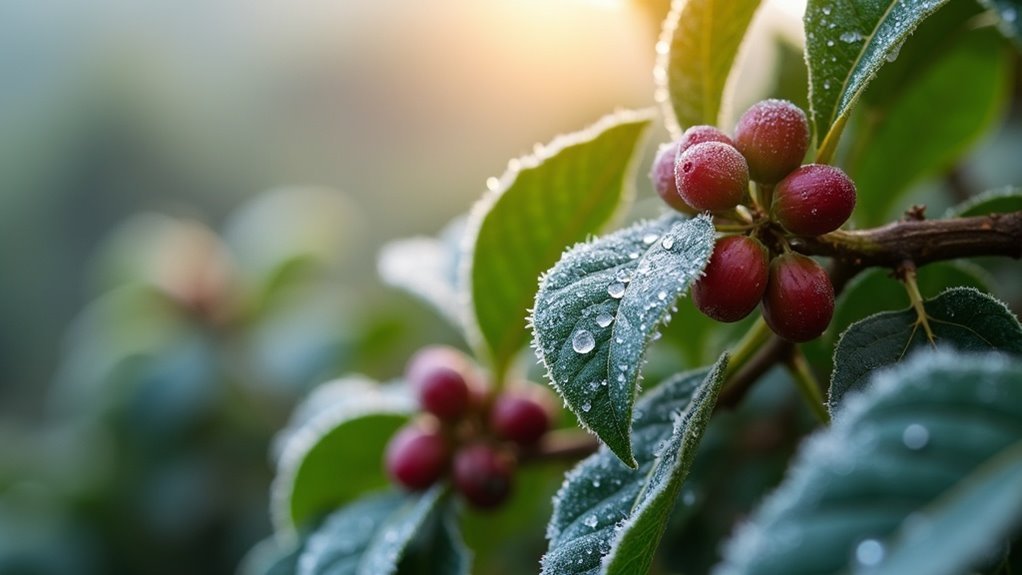
Frost impacts coffee crops by causing varying levels of damage. White frost results in minor harm, while black frost can lead to irreversible destruction of plant structures, resulting in long-term declines in productivity. Recovery from severe frost can take 1 to 2 years, and complete restoration may require up to 7 years. The economic consequences are significant, with substantial production losses and rising market prices. Additionally, the effects of climate change exacerbate these risks, highlighting the importance of understanding future challenges for coffee production. There’s much more to explore regarding these impacts on coffee crops.
Key Takeaways
- Frost can cause significant damage to coffee crops, with black frost leading to irreversible harm and complete defoliation.
- Recovery from frost damage may take 1 to 2 years, with full restoration potentially extending to 4 to 7 years.
- Economic losses from frost can range from 2.5 to 10 million bags of coffee, which significantly impacts supply and prices in the coffee market.
- Climate change increases the risk of frost events, exacerbating stress on coffee plants and threatening future yields, which is a concern for coffee lovers and producers alike.
- Market volatility caused by frost damage affects consumer prices, potentially leading to shifts in purchasing behaviors towards more affordable coffee options.
Understanding Frost and Its Types
How does frost impact coffee crops? Understanding frost and its types is essential for coffee production.
Frost occurs when air temperatures drop below freezing, forming ice crystals that can severely damage coffee plants. Two types of frost affect coffee: white frost, which causes minor harm, and black frost, which occurs at sub-zero temperatures and leads to irreversible damage.
Frost can severely damage coffee plants, with white frost causing minor harm and black frost leading to irreversible effects.
Black frost can burn leaves black and brown, destroying critical flower buds and fruits, which are vital for coffee yield. After severe frost damage, affected coffee plants may take up to two years to recover, and complete restoration could stretch to 4 to 7 years if replacement is necessary, especially following drought conditions that weaken plant resilience.
Protecting coffee crops from frost is crucial for maintaining optimal production levels.
The Effects of Frost on Coffee Plants
Frost can severely impact coffee plants, with black frost inflicting irreversible damage that disrupts the plant’s cellular structure.
Visible signs include blackened leaves and complete defoliation, complicating recovery efforts.
Understanding the types of frost damage is essential for coffee growers, as it can influence both immediate responses and long-term strategies for restoring productivity in coffee crops.
Types of Frost Damage
The impact of frost on coffee plants can be categorized into two primary types: white frost and black frost.
White frost generally causes minor crop damage, while black frost poses a severe threat, often leading to the death of coffee trees.
Black frost occurs under sub-zero temperatures, damaging flower buds, flowers, and fruits, resulting in significant losses for coffee producers.
Frost burns on leaves can mimic human frostbite, causing browning or complete defoliation of the coffee plants.
Prior drought conditions heighten susceptibility to frost damage, complicating recovery efforts for coffee growers.
Ultimately, understanding these frost types is essential for effective management and sustained coffee production in the face of challenging climatic conditions.
Recovery Challenges Post-Frost
While recovering from frost damage may seem daunting, having a clear understanding of the challenges can assist coffee producers in managing this intricate process. In Minas Gerais, coffee farmers encounter considerable recovery obstacles. Frost can result in complete defoliation, which can lead to long-term declines in production. The recovery time can range from one to two years, while replacing damaged trees may extend the timeline to four or five years. The table below highlights key recovery challenges faced by coffee producers:
| Challenge | Duration |
|---|---|
| Recovery from frost damage | 1-2 years |
| Tree replacement | 4-5 years |
| Productivity assessment | 60 days or longer |
| Impact of defoliation | Multiple growing cycles |
| Prior drought effects | Increased vulnerability |
Economic Consequences of Frost Damage
When coffee crops suffer from frost damage, the economic repercussions can be severe and far-reaching.
In Brazil, producers of coffee may face losses of 2.5 to 10 million bags, driving prices up due to diminished supply. Severe frosts often necessitate replanting, delaying fruit production for 4 to 7 years and intensifying economic consequences.
The market typically reacts with sharp price increases; for instance, light frosts in August 2024 caused prices to spike to a seven-year high.
Additionally, drought conditions can exacerbate frost damage, threatening future yields and further jeopardizing the stability of farming communities reliant on coffee production.
Recovery Challenges for Coffee Farmers
Recovering from frost damage presents substantial challenges for coffee farmers.
It can take one to two years for affected coffee trees to regain their health, and if frost results in plant death, you may have to wait four to five years for newly planted trees to begin bearing fruit.
To navigate the complexities of replanting and optimize recovery efforts, effective crop management and timely monitoring are essential in the coffee industry.
Timeframe for Recovery
Frost damage can severely disrupt the recovery timeline for coffee farmers, often stretching from one to two years, depending on the frost’s severity and the trees’ prior health.
In the state of Minas Gerais, higher temperatures preceding frost can worsen damage, complicating the recovery of affected coffee crops.
Young coffee plants are particularly vulnerable, requiring careful assessment after frost events.
The economic burden on farmers can be significant, as damaged coffee crops lead to reduced yields and increased replanting costs.
Ultimately, the recovery process for coffee farming is complex, influenced by environmental conditions and the need for effective management strategies to support regrowth.
Replanting and Crop Management
Replanting coffee crops after significant frost damage presents numerous challenges for farmers, particularly when it comes to effective crop management. The process can take years, with recovery from frost damage lasting one to two years and full production restoration up to seven years. Farmers often face shortages in nurseries, complicating timely replanting efforts. Pruning frost-affected coffee trees is essential for recovery, especially after severe damage.
| Challenge | Impact on Recovery | Management Strategy |
|---|---|---|
| Frost Damage | Delayed production | Pruning affected coffee trees |
| Tree Replacement | Increased costs | Timely replanting of coffee |
| Nursery Shortages | Limited options | Alternative sourcing for seedlings |
| Drought Conditions | Increased vulnerability | Irrigation support for coffee crops |
Farmers must navigate these challenges to ensure the successful reestablishment of their coffee plantations and to ultimately restore productivity.
Climate Change and Increased Frost Risk
As climate change accelerates, the risk of frost events becomes an increasingly critical concern for coffee producers, particularly in Brazil, one of the world’s largest coffee-growing regions.
In Minas Gerais, rising temperatures lead to more extreme weather, increasing the likelihood of severe frost. These events, especially following drought, can devastate coffee production as stressed trees struggle to survive.
Historical data reveals that significant frost occurrences have drastically impacted coffee yields, causing prices to soar. The recovery from such damage can take years, complicating the long-term sustainability of coffee farming amidst the challenges posed by climate change.
The Global Impact of Frost on Coffee Prices
While climate variability continues to challenge coffee production, the recent light frosts in Brazil’s Cerrado Mineiro region have sparked a notable increase in Arabica coffee prices, reaching levels not seen in nearly seven years.
With estimates of 4.5 to 5 million bags lost due to frost, Brazil’s coffee supply is under threat, directly impacting global availability.
Estimates suggest frost has decimated 4.5 to 5 million bags of Brazil’s coffee, jeopardizing global supply.
Historical patterns suggest that severe frost events lead to drastic price spikes, reminiscent of the 1994 crisis.
As futures prices surge by 30%, major coffee brands are adjusting their prices, leaving smaller roasters to face tough decisions.
The ripple effects on coffee prices could last for years, affecting consumers and coffee enthusiasts alike.