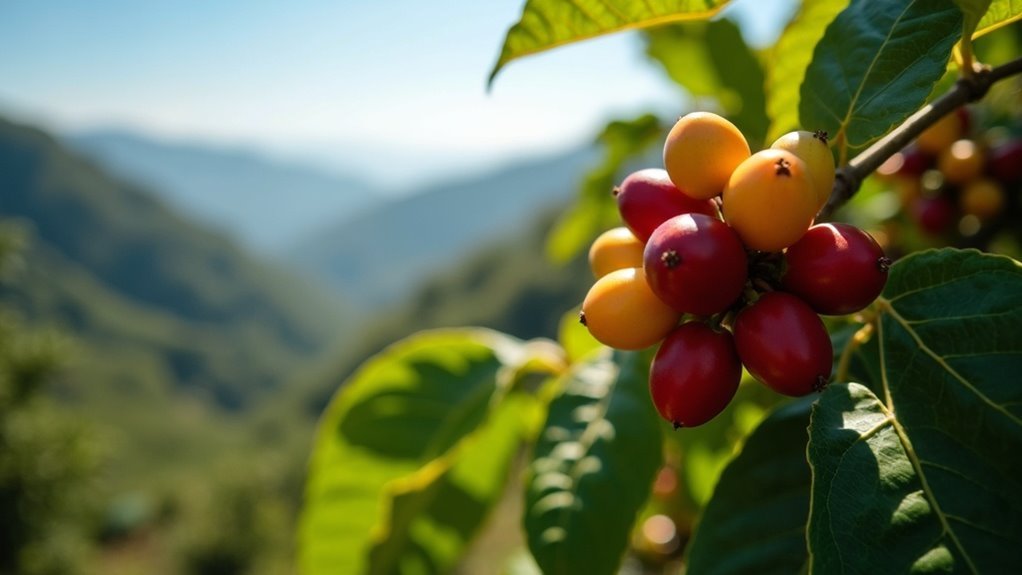
Catimor coffee is a hybrid variety that has gained popularity due to its unique blend of robusta resilience and arabica flavor. Developed in Portugal in 1959, it was specifically designed to combat the coffee leaf rust epidemic. Thriving at lower altitudes, Catimor offers high yields and disease resistance, making it suitable for a variety of climates. With complex tasting notes and notable health benefits, this coffee’s attributes are capturing the attention of specialty markets. Stay tuned to discover more about its cultivation and related varieties!
Key Takeaways
- Catimor coffee is a hybrid variety developed in 1959, combining robusta traits with the Caturra cultivar to enhance disease resistance and increase yields.
- This coffee thrives at elevations below 1650 meters above sea level, requiring ample rainfall and allowing for high-density planting, making it suitable for diverse growing conditions.
- Cultivated across various regions, including Central and South America, Africa, and Asia, Catimor is noted for its adaptability and productivity in different climates.
- The flavor profile of Catimor coffee is complex, featuring bright fruit flavors, herbal nuances, and a smooth body, often achieving high cupping scores when processed properly.
- In addition to its delightful taste, Catimor coffee offers health benefits, being rich in antioxidants and essential nutrients, while also promoting sustainable farming practices within the coffee industry.
Genetics of Catimor Coffee
When you explore the genetics of Catimor coffee, you’ll discover a fascinating hybrid developed in Portugal in 1959.
This cultivar combines the robusta traits of the Timor varietal, which offers resistance to coffee leaf rust, with the high yield and superior flavor characteristics of the Caturra cultivar.
The Catimor cultivar blends Timor’s robusta traits for disease resistance with Caturra’s high yield and exceptional flavor.
The compact stature of Catimor plants makes them ideal for large-scale coffee farming and easier maintenance.
Its genetics enable it to thrive across diverse growing conditions, although environmental factors can greatly influence performance and flavor.
Farmers, especially in Vietnam, favor Catimor for its high yield potential and inherent disease resistance.
Tasting Notes
Catimor coffee offers a distinctive tasting experience characterized by its complex flavor profiles. The tasting notes reveal ripe berries alongside herbal nuances, creating a unique flavor that captivates coffee enthusiasts.
You’ll appreciate the nutty undertones that harmonize with fruity cherry flavors, resulting in a well-balanced palate. Bright, lively fruit flavors paired with a hint of acidity and sweetness enhance your overall taste journey.
The smooth body and long, rich finish make Catimor coffee beans appealing to diverse drinkers. With potential cupping scores in the mid to high 80s, it consistently delivers excellent flavor when processed with care.
History of Catimor Development
Developed in Portugal in 1959, the Catimor coffee varietal emerged as an essential solution to the coffee leaf rust epidemic that plagued Central America.
This hybrid, combining the disease-resistant Timor coffee bean with the flavorful Caturra cultivar, showcased significant advancements in sustainability and productivity within the coffee industry.
Combining disease resistance with rich flavor, Catimor represents a significant step forward in sustainable coffee cultivation.
The history of Catimor reflects its growing popularity, particularly in Vietnam, where farmers appreciate its hardiness and adaptability in coffee cultivation.
As it bridges the gap between robusta and arabica characteristics, Catimor coffee continues to address challenges faced by coffee producers, ensuring a reliable supply while enhancing flavor profiles that cater to diverse consumer preferences in the world of coffee.
Cultivation and Growing Conditions
For ideal growth, Catimor coffee thrives in specific environmental conditions that greatly influence its yield and flavor.
This variety flourishes at altitudes below 1650 meters above sea level and benefits from ample rainfall, making it suitable for diverse regions in Southeast Asia and beyond.
Its compact size allows for high-density planting, ideally 3000-4000 plants per hectare, utilizing single-stem pruning.
While Catimor demonstrates high yield potential with rapid cherry production, careful cultivation practices are essential, as environmental factors can affect the coffee’s cup quality.
Additionally, its intermediate resistance to coffee leaf rust offers resilience in susceptible areas, enhancing its viability for growers.
Flavor Profile and Characteristics
When you taste Catimor coffee, you’ll experience a delightful spectrum of flavors, featuring ripe berries, nutty undertones, and herbal notes.
The bright acidity harmonizes beautifully with its natural sweetness, resulting in a vibrant flavor profile that coffee lovers truly cherish.
Furthermore, the aroma presents captivating hints of black tea, spices, and chocolate, enriching your overall sensory journey with each sip.
Tasting Notes Overview
Catimor coffee offers a captivating flavor profile that blends ripe berries, cherry, and herbal notes, resulting in a vibrant tasting experience.
With its diverse tasting notes, you’ll encounter:
- A harmonious balance of acidity and sweetness
- Hints of brown sugar and vanilla
- Subtle spice undertones
- A smooth, satisfying finish
This coffee variety caters to a wide array of palates, making it suitable for various brewing methods.
When processed with care and cultivated in optimal conditions, Catimor coffee reveals these exceptional characteristics, ensuring that each sip is both delightful and memorable.
It’s a true pleasure for anyone seeking to serve outstanding coffee.
Aroma and Body
The aroma and body of Catimor coffee provide an intriguing introduction to its flavor profile, captivating coffee enthusiasts with its complexity.
You’ll detect nutty and herbal scents, enhanced by distinct cherry and berry notes. This coffee’s bright, vibrant fruit flavors create a delightful balance of acidity and sweetness.
Its smooth body enriches the experience, leading to a long, satisfying finish that lingers pleasantly on the palate.
When grown under optimal conditions, Catimor can achieve impressive cupping scores in the mid to high 80s.
Unique hints of brown sugar, vanilla, and nectarine further highlight its versatility, making it an exciting choice for coffee lovers.
Global Distribution of Catimor Coffee
Catimor coffee’s global distribution spans major coffee-producing regions like Central and South America, Africa, and Asia.
You’ll find significant cultivation in countries such as Vietnam and India, where its high yield and disease resistance are appealing to farmers.
As market trends shift, understanding the demand for Catimor across these key growing countries reveals its adaptability and importance in the coffee industry.
Major Coffee Producing Regions
Several key regions around the world are instrumental in the cultivation of Catimor coffee, reflecting its diverse adaptability and significance in global coffee production.
Particularly, it thrives in:
- Central and South America
- Africa, especially Zambia, Malawi, and Zimbabwe
- Vietnam, where its robusta lineage complements arabica flavors
- Yunnan, China, which produces over 90% of the country’s coffee beans
These regions highlight Catimor’s resilience against challenges such as coffee leaf rust, making it a favored choice among coffee producers.
The combination of robusta hardiness and desirable flavor profiles enhances its role in meeting the needs of diverse coffee markets worldwide.
Key Growing Countries
Across multiple continents, Catimor coffee has established a strong presence, with significant cultivation in key countries known for their unique climates and agricultural practices. In Central and South America, Colombia and Brazil lead in production, renowned for their high yield and unique flavors. Africa’s Zambia, Malawi, and Zimbabwe appreciate Catimor for its disease resistance, which helps ensure a consistent supply. In Asia, Vietnam showcases the rising popularity of Catimor, while Yunnan, China, contributes over 90% of the country’s coffee output, demonstrating the variety and adaptability of this coffee across diverse climates. This global distribution highlights Catimor’s ability to thrive in various environments, making it a versatile choice for coffee lovers worldwide.
| Region | Key Countries | Notable Features |
|---|---|---|
| Americas | Colombia, Brazil | High yield, unique flavors |
| Africa | Zambia, Malawi, Zimbabwe | Disease resistance |
| Asia | Vietnam, China | Adaptability, growing demand |
Market Trends and Demand
The global distribution of Catimor coffee highlights a notable shift in consumer preferences and agricultural practices within the coffee industry. This cultivar’s rising popularity is reshaping the landscape of coffee production, as farmers increasingly recognize its advantages.
Here are the key factors driving demand for Catimor coffee:
- High yield and disease resistance, particularly in Southeast Asia, with Vietnam leading the way
- A unique combination of robusta hardiness and arabica flavor that appeals to specialty coffee markets
- Significant production in Yunnan, China, demonstrating the cultivar’s adaptability to various climates
- New generations of farmers are adopting Catimor for its economic viability and sustainability
As Catimor coffee continues to develop, its potential in both mainstream and specialty coffee segments becomes more apparent, catering to a wide range of consumer tastes and preferences.
Health Benefits of Catimor Coffee
While exploring the health benefits of Catimor coffee, you’ll discover that it presents a diverse range of nutrients and bioactive compounds that enhance overall wellness. Its antioxidants effectively combat oxidative stress, while essential minerals such as magnesium and potassium play a crucial role in supporting heart health and regulating blood pressure. Furthermore, niacin (vitamin B3) aids in energy metabolism, and vitamin E contributes to improved skin health. Regular consumption of Catimor coffee may also enhance cognitive function and reduce the risk of neurodegenerative diseases.
| Nutrient | Benefit | Source |
|---|---|---|
| Antioxidants | Combat oxidative stress | Catimor coffee |
| Magnesium | Maintains heart health | Catimor coffee |
| Potassium | Regulates blood pressure | Catimor coffee |
| Niacin (B3) | Supports energy metabolism | Catimor coffee |
Related Varieties and Their Attributes
As you delve into the world of Catimor coffee, it’s important to understand the related varieties that enhance its cultivation and sustainability.
These varieties contribute unique attributes to coffee production:
- Kartika 1: Well-suited for agroforestry, it boasts high resistance to rust and delivers good yields.
- T8667: Known for its high yield and rust resistance, it thrives in warm climates and acidic soils.
- T5175: This variety yields well at lower altitudes but requires substantial fertilization, with its quality varying.
- Robusta inheritance: It inherits the hardiness of robusta coffee while also improving flavor and yield.
These advancements highlight the ongoing efforts to tackle global farming challenges and promote sustainability in coffee production.