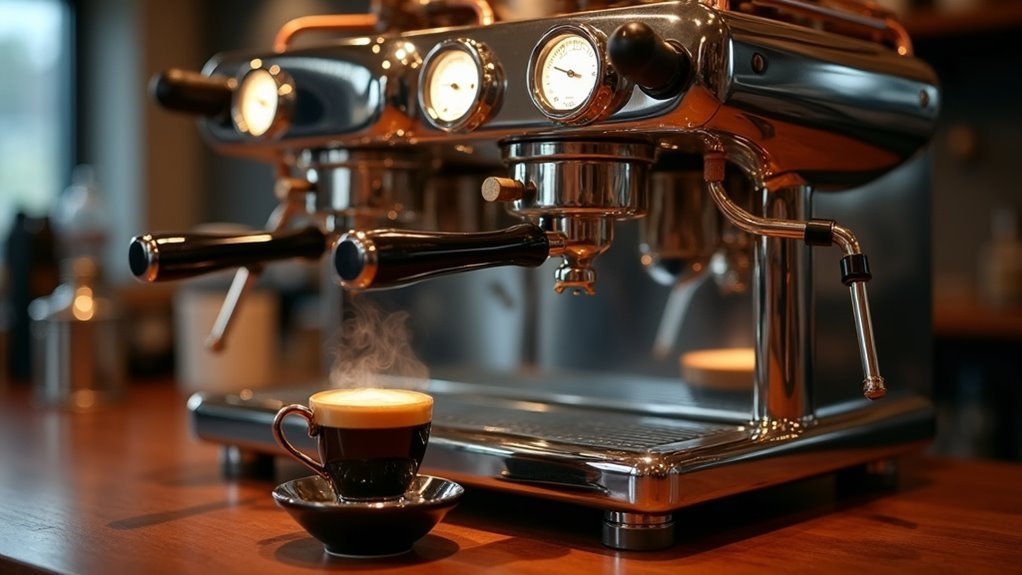
A heat exchanger espresso machine is a popular brewing device among coffee enthusiasts that utilizes a single boiler to efficiently heat water for both brewing espresso and steaming milk. This innovative design facilitates rapid temperature recovery, allowing you to prepare multiple drinks in quick succession without compromising on quality. Generally, heat exchanger machines are more budget-friendly compared to dual boiler models, but it’s crucial to manage temperature stability to ensure that each cup delivers a consistent and delightful flavor profile. Interested in learning more about the advantages, disadvantages, and helpful tips for selecting the perfect model for your coffee needs?
Key Takeaways
- A heat exchanger espresso machine is designed to brew coffee and steam milk simultaneously using a single boiler, which enhances efficiency for coffee enthusiasts.
- It incorporates a coil that effectively transfers heat from the steam boiler to the brewing water, allowing for rapid heating and optimal brewing conditions.
- These machines are compact and budget-friendly, making them perfect for coffee lovers with limited space or financial considerations.
- However, temperature stability can be an issue; cooling flushes are often needed to ensure that brewing temperatures are stabilized before extracting espresso.
- Many heat exchanger machines come equipped with PID controllers, which are instrumental in maintaining ideal brewing temperatures, ensuring consistent and high-quality espresso with every cup.
What Is a Heat Exchanger?
A heat exchanger in an espresso machine is a crucial component that facilitates efficient brewing and steaming of coffee.
This system utilizes a single boiler to simultaneously heat water for both processes, with a coil transferring heat from the steam boiler to the brewing water.
You’ll appreciate the rapid heating capability, enabling you to steam milk and pull espresso shots back-to-back without any delays.
Typically, steam temperatures range from 255 to 265°F, while ideal brew temperatures remain between 192 to 204°F for optimal espresso extraction.
Don’t forget to perform a cooling flush before brewing to stabilize temperatures and ensure consistent espresso quality.
Advantages of Heat Exchanger Machines
Why choose a heat exchanger espresso machine for your coffee needs?
These machines excel at allowing you to brew and steam simultaneously, making them perfect for crafting milk-based drinks without delay. Their compact design is ideal for limited counter spaces, while their cost-effectiveness saves you hundreds compared to dual boiler models.
The rapid recovery time of heat exchanger machines ensures you can serve multiple drinks in busy coffee environments. With features like PID controllers, you can achieve enhanced temperature control, maintaining the ideal temperature for brewing coffee and steaming milk.
This precision elevates your coffee brewing experience, guaranteeing quality in every cup served.
Disadvantages of Heat Exchanger Machines
While heat exchanger machines offer some benefits for coffee enthusiasts, they do come with notable drawbacks.
You’ll often need to perform a cooling flush before brewing to achieve stable temperatures, which can slow down your coffee-making process.
Additionally, temperature stability can fluctuate, making it harder to consistently extract the best flavors from your espresso.
Temperature Stability Issues
While heat exchanger espresso machines are favored for their ability to brew and steam simultaneously, they do present notable temperature stability challenges that can influence the quality of your espresso.
Fluctuations in brew temperature can result in inconsistent espresso extraction, leading to varying flavor profiles. Achieving precise temperature control is essential, which often requires the technique known as temperature surfing—manually adjusting the brew temperature to obtain optimal results.
Furthermore, the need for a cooling flush before pulling shots adds to the complexity of the process, increasing the time involved and introducing potential for error.
With brew and steam temperatures differing by over 40°F, maintaining consistent espresso quality can be particularly daunting, especially for those new to the art of coffee making.
Cooling Flush Requirement
To achieve ideal espresso extraction, heat exchanger machines necessitate a cooling flush before pulling shots. This process stabilizes the brew temperature, as water in the heat exchange tube can be overheated from recent steaming.
By running a small amount of water through the group head, you adjust the temperature, but it can waste some coffee and water if not managed properly. New users should develop a routine for these flushes to guarantee optimal flavor extraction.
Regular cooling flushes prevent overheating the group head, which can lead to bitter or over-extracted espresso shots, compromising the quality of your coffee.
Less Precise Control
While heat exchanger machines provide a more budget-friendly option for espresso brewing, they do come with the drawback of less precise temperature control.
These machines often depend on a technique called temperature surfing to reach optimal brewing temperatures, which can lead to inconsistencies if not executed skillfully.
Unlike dual boiler machines, heat exchangers don’t offer independent temperature control, resulting in potential fluctuations in brew temperature during use.
This variability can affect flavor extraction, particularly when pulling consecutive shots.
Additionally, to maintain temperature stability, a cooling flush is often required, which adds complexity to the espresso-making process and makes it more difficult to consistently achieve high-quality results.
Importance of Brewing Temperature
When brewing espresso, maintaining the ideal temperature—between 192 to 204 degrees Fahrenheit—is crucial for achieving the best flavor extraction from your coffee grounds.
Maintaining a brewing temperature of 192 to 204°F is essential for optimal coffee flavor extraction.
Variations in brewing temperature can lead to:
- Over-extraction, resulting in bitter flavors.
- Under-extraction, causing sour and weak tastes.
- Inconsistent espresso quality, which can be frustrating for coffee enthusiasts.
- The need for temperature surfing techniques, particularly with heat exchanger machines.
Using a PID controller can help stabilize brewing temperature, minimizing fluctuations that could compromise your espresso.
How to Choose Between Heat Exchanger Machines
Finding the right heat exchanger machine for your coffee brewing needs involves understanding your specific preferences.
Look for models with PID temperature control to enhance thermal stability, ensuring that your brew temperatures remain consistent within 1–2 degrees. If you often prepare 1–3 cups of coffee per session, heat exchanger machines are ideal, as they allow for quick recovery between shots without the need for cooling flushes.
Be sure to assess your kitchen space, as these machines tend to be more compact compared to dual boiler espresso machines.
Lastly, consider your budget; heat exchanger machines are typically a cost-effective choice for casual coffee enthusiasts seeking quality performance without the higher price tag of dual boilers.
A Brief History of Heat Exchanger Machines
Although espresso machines have undergone significant advancements since their inception, heat exchanger machines emerged as a revolutionary solution in the mid-20th century, particularly in Italian cafés.
These machines fundamentally transformed coffee preparation by addressing early limitations and enabling:
- Simultaneous brewing and steaming for a seamless coffee experience.
- Efficient use of a single boiler design that optimizes energy consumption.
- Durable thermosyphon systems that enhance mechanical simplicity and reliability.
- Quick recovery times between shots, allowing for uninterrupted service.
Over the years, heat exchanger machines have evolved to incorporate advanced brewing techniques, ensuring their continued relevance in both professional coffee setups and home brewing.
They’ve become essential tools for baristas dedicated to serving high-quality coffee with precision and finesse.