Decaf beans are indeed harder to grind than caffeinated ones. This increased difficulty stems from their brittleness, which arises during the decaffeination process. The brittleness leads to more fines during grinding, resulting in inconsistent grind sizes. It’s vital to adjust your grinding technique for decaf to avoid over-extraction and ensure peak flavor. Monitoring grind size and managing fines is essential for brewing perfection. Curious about how these factors affect your coffee brewing and flavor? There’s more to discover about the nuances of decaf coffee!
Key Takeaways
- Decaf beans tend to be harder to grind compared to regular beans due to increased brittleness resulting from the decaffeination process.
- This brittleness can lead to a higher production of fines, making the grinding process more challenging.
- It is advisable to start with coarser grind settings to better manage the brittleness of decaf beans.
- Keeping a close eye on grinder settings is crucial for achieving consistent grind sizes when working with decaf beans.
- Regular maintenance and cleaning of grinders are important to avoid flavor contamination from any residual decaf bean particles.
Understanding the Brittleness of Decaf Beans
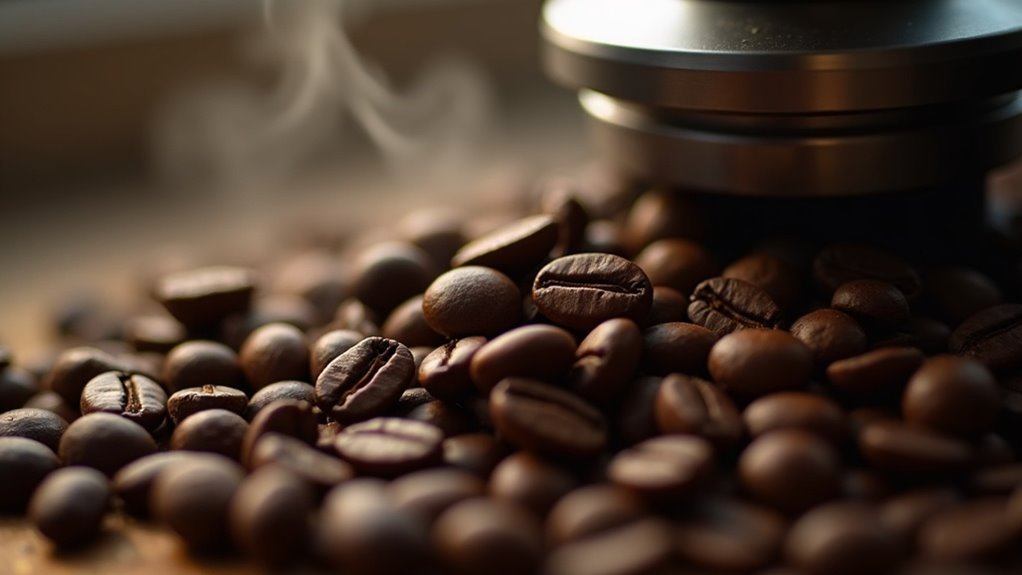
When you grind decaf beans, you’ll notice they tend to be more brittle than their caffeinated counterparts, largely due to the decaffeination process. This brittleness results from structural changes in the beans, making them more susceptible to forming fines during grinding.
Consequently, when ground too coarsely, decaf beans can gush, negatively affecting your extraction process. To achieve the best flavor balance, you’ll need to grind them finer than regular beans.
Additionally, the loss of water-soluble compounds complicates grinding and brewing, emphasizing the importance of understanding how decaf beans behave to guarantee a satisfying coffee experience for those you serve.
The Impact of Decaffeination on Grinding
Although decaffeination serves the purpose of reducing caffeine content, it significantly alters the structural integrity of the beans, which directly affects the grinding process.
When grinding decaf coffee, keep in mind the following factors:
- Brittleness: Decaf beans tend to be more brittle, resulting in a higher production of fines and inconsistent grind sizes.
- Grind Size: Due to the loss of water-soluble compounds, a finer grind is often needed for optimal extraction.
- Brewing Precision: Coarse grinds can lead to gushing during espresso shots, underscoring the importance of precise adjustments to prevent over-extraction.
Grinding Techniques for Decaf Coffee
For those looking to perfect their decaf coffee experience, mastering the grinding technique is essential.
Start with a coarser grind size, then refine it gradually to achieve ideal extraction without risking over-extraction. Decaf beans are more brittle, often resulting in more fines, so be mindful of your grinder settings.
Regularly clean your grinder to avoid old coffee residues affecting flavor. Additionally, using a puck screen during brewing can enhance water distribution and mitigate channeling, which is especially important with the finer grind size of decaf.
The Role of Fines in Extraction
When you grind decaf coffee beans, the presence of fines plays a significant role in the dynamics of extraction.
These small particles can either enhance or hinder your brew quality, depending on how you manage them.
Fines and Extraction Dynamics
As you delve into the realm of decaf coffee, grasping the significance of fines in extraction is crucial.
Fines have a substantial impact on extraction dynamics in several ways:
- They can obstruct the puck, affecting flow rates during brewing.
- Fines facilitate consistent water channeling through the coffee grounds, promoting uniform extraction.
- A lack of fines may result in gushing espresso shots, leading to uneven flavors.
Since decaf beans tend to be more brittle, you’ll likely encounter an increased amount of fines during the grinding process.
Therefore, adjusting the grind size and brewing methods becomes essential to effectively manage fines, ensuring a balanced and flavorful cup for your enjoyment.
Impact on Brew Quality
Understanding the impact of fines on brew quality is essential for optimizing decaf coffee extraction. When grinding decaf, the increased brittleness of the beans often leads to more fines, which can negatively affect extraction.
Insufficient fines may cause gushing during espresso extraction, resulting in uneven flavors. Fines help to clog the puck, and their reduction means you’ll need to adjust grind size for balanced flavors.
Furthermore, due to decaf’s higher solubility, over-extraction is more likely, making fines vital for managing extraction dynamics.
Effectively managing grind size and the presence of fines directly influences the flavor and body of your final cup, ensuring a more enjoyable coffee experience.
Adjusting Grind Size
Adjusting grind size for decaf coffee is essential for achieving optimal extraction, especially considering the unique characteristics of decaf beans.
To enhance your brewing process, consider these points:
- Grind Finer: Decaf beans are more brittle, producing excess fines that can affect flavor. A finer grind ensures better extraction.
- Monitor Flow: Fines play a crucial role in regulating espresso flow; a lack of fines can lead to gushing and inconsistent results.
- Optimize Body: Using a coarser grind may under-extract the coffee, resulting in a lack of body and richness in flavor.
Keep these adjustments in mind for a superior decaf coffee experience!
Adjustments for Optimal Decaf Espresso
While brewing decaf espresso, achieving the right grind size is essential for ideal extraction.
Decaf beans, being more brittle, produce more fines during grinding, which can hinder the quality of your shot. You’ll typically need to adjust your grinder by about 1.5 stops or 15 clicks to achieve a finer grind.
Keep an eye on your brew time; aim for around 20 seconds to prevent over-extraction and bitterness. Using a puck screen can enhance water distribution, minimizing channeling issues.
Additionally, carefully monitor grind size and dosing, as a higher dose can improve body but risk under-extraction if not balanced.
Enjoy the nuances of decaf espresso and explore different beans to find your perfect cup!
Brewing Ratios and Their Importance
When brewing decaf coffee, the right brewing ratio is essential for balancing flavors and achieving a satisfying cup.
Starting with a 1:2 ratio, you can adjust according to your taste preferences and the characteristics of the decaf beans.
Experimenting with these ratios allows you to enhance sweetness and body, leading to a more enjoyable coffee experience.
Optimal Brew Ratios
Finding the right brew ratio is essential for revealing the unique flavors of decaf coffee, as it directly influences the extraction process and the overall taste experience.
To optimize your brews, consider these key points:
- Use a ratio of 1:1.5 to 1:2 for a balanced flavor profile.
- Experiment with increasing to 1:2.2 (18 grams in, 40 grams out) to enhance sweetness.
- Keep brew time around 20 seconds to avoid bitterness from over-extraction.
Since decaf beans have fewer soluble compounds due to the decaffeination process, fine-tuning your ratios is vital for achieving a rich, flavorful cup of coffee.
Adjusting for Decaf
Adjusting brewing ratios for decaf coffee is essential to access its full flavor potential, as the decaffeination process alters the beans’ solubility and extraction characteristics.
When grinding decaf, aim for a typical ratio of 1:2, but be prepared to experiment. Since decaf beans are more soluble, shorter brew times of around 20 seconds can prevent bitterness.
Consider higher coffee-to-water ratios to enhance complexity, but monitor extraction times closely, as they vary from caffeinated beans.
Utilizing puck screens can improve water distribution and extraction balance, which is vital for avoiding channeling and ensuring a well-rounded cup of decaf.
Mindset Shifts for Enjoying Decaf Coffee
Although many coffee enthusiasts initially approach decaf with skepticism, shifting your mindset can transform the experience into one of genuine enjoyment.
To fully appreciate decaf coffee, consider these points:
- Focus on Flavor: Embrace the unique taste profiles of decaf coffee beans, which can surprise you with their distinct characteristics compared to regular coffee.
- Adjust Brewing Techniques: Experiment with lower brew times and the right grind sizes to enhance the quality of your decaf cup, allowing the flavors to shine through.
- Appreciate Aesthetics: Recognize that a thinner crema doesn’t diminish the overall taste experience; instead, it can highlight the subtleties of the coffee’s flavor.